WANT TO TAKE ACTION NOW?
Updated June 25, 2026 – The Office of Management and Budget (OMB) is considering a proposed rule that could have significant implications for nonprofits, higher ed, and others that receive federal grants.
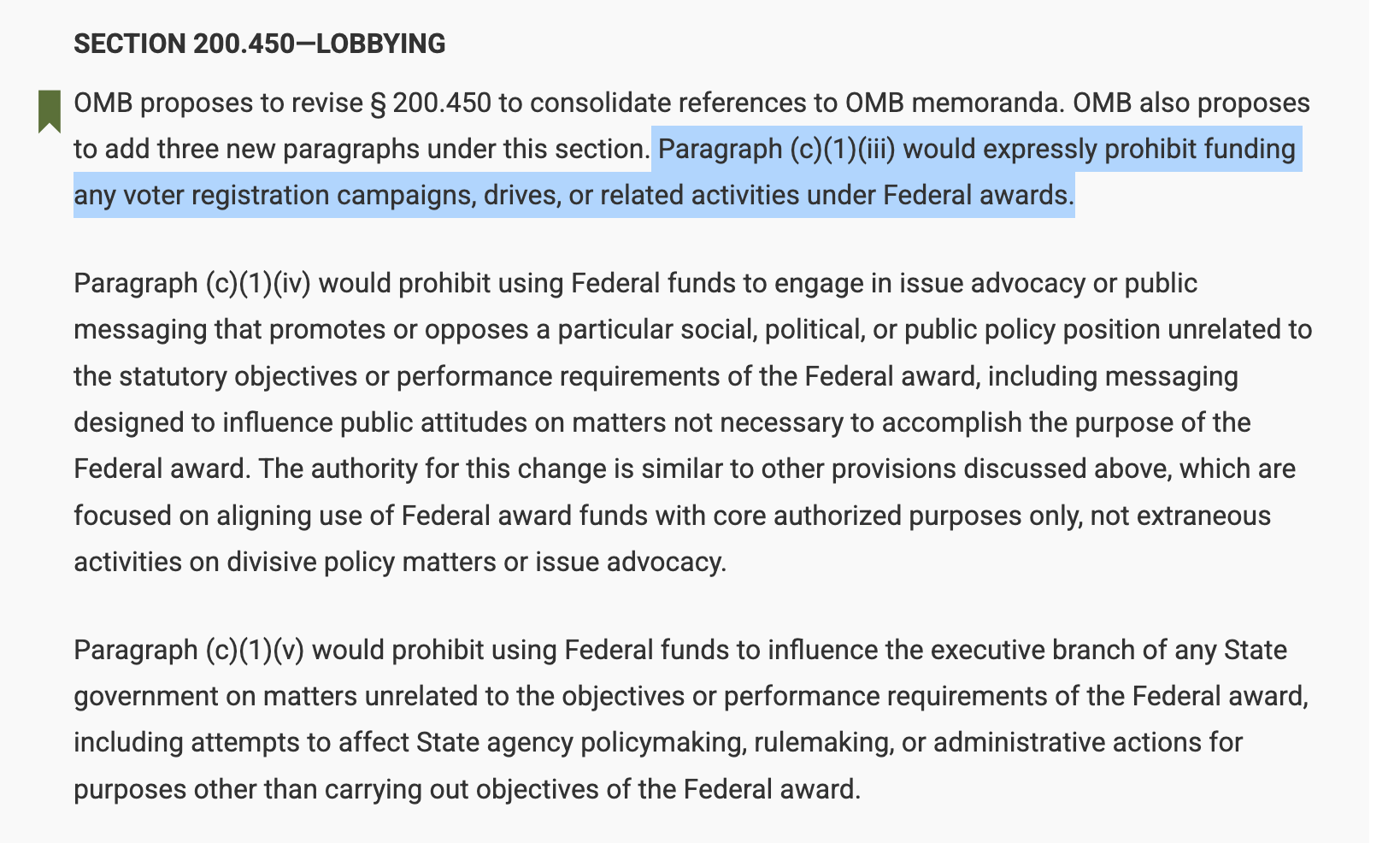
Although much of the proposal focuses on other policy areas, including embedding the Administration’s anti-DEI views and requiring grants to align with the Administration’s policy priorities, one provision will expand restrictions related to voter registration activities and public policy advocacy conducted by grant recipients.
Released on May 29, 2026, public comments on the proposal are due by July 13, 2026.
What Would Change?
Currently, only a small number of federal grant programs have explicit restrictions on voter registration activities including Community Services Block Grants (CSBG), Head Start, and AmeriCorps. The proposed voter registration rule, which would be implemented without seeking the approval of Congress, would implement a broader ban that applies to all federal grants to nonprofits and institutions of higher education.
The proposal would NOT prohibit nonprofits or higher ed from conducting lawful, nonpartisan voter registration activities, even if they are recipients of federal grants, provided they use non-federal funds to pay for the registration activities. However, the language could create significant confusion about what organizations can and cannot do.
Similarly, there is already a ban in place that prohibits the use of federal grant money for lobbying. However, lobbying has a very specific, well-understood definition that generally requires communicating with a policy maker, their staff, or agency official about a specific piece of legislation or policy. This new provision would expand that ban to cover a much broader set of communications that fall under issue advocacy and related messaging. The newly-expanded, highly-subjective restriction could have a significant impact on an organization’s ability to discuss issues tied to housing, food security, education, or climate change.
Why Nonprofits and Others Are Concerned?
The biggest concern may not be the direct legal impact of the rule, but its practical effect. Many nonprofits, as well as higher ed, receive federal funding while also operating programs supported by private donations, foundations, state grants, or other funding sources. When rules become more complex or unclear, organizations often become more cautious.
As a result, some organizations may mistakenly conclude that receiving any federal funding means they cannot engage in voter registration activities at all—even when those activities are lawful and supported entirely by non-federal funds.
This kind of confusion can have a chilling effect, causing organizations to reduce or abandon civic engagement efforts that help community members participate in democracy.
Conflicts With Existing Law
The voter registration portion of the proposed OMB rule raises questions about consistency with existing federal law.
The National Voter Registration Act (NVRA) of 1993 requires organizations administering certain federal programs to provide voter registration assistance. In addition to requiring voter registration at state motor vehicle offices, the NVRA also requires programs such as TANF, WIC, Medicare, and SCHIP to offer voter registration opportunities. And when a nonprofit receives a grant or contract to administer such programs, they are also obligated to help eligible individuals register to vote. Higher ed institutions providing state-funded support for people with disabilities are also covered under the NVRA.
The proposed rule directly conflicts and creates confusion about these obligations.
More Red Tape, Little Added Benefit
Nonprofits that receive federal grants already operate under extensive compliance requirements designed to ensure public funds are used appropriately to achieve grant and program objectives.
Many organizations carefully separate funding sources and track expenditures to comply with existing restrictions.
Critics of the proposal argue that adding another layer of restrictions could increase administrative burdens without addressing a demonstrated problem, while making organizations less likely to engage in lawful civic participation activities.
Timeline: What Happens Next?
- May 29, 2026: OMB published the proposed rule.
- July 13, 2026: Public comments are due. This is the nonprofit sector’s opportunity (and higher ed) to raise concerns, share real-world impacts, and suggest changes before the rule is finalized.
- September 1, 2026 (anticipated): OMB is expected to publish a final rule, giving the agency less than two months to review and respond to public comments.
- October 1, 2026: The rule could take effect at the start of the federal fiscal year.
This compressed timeline has raised serious concerns among nonprofit leaders. If finalized, the rule could take effect just weeks before the midterm election as many organizations are running fully-permissable nonpartisan voter registration drives, causing many to halt operations until the new rules are fully understood. Even before implementation, uncertainty surrounding the proposal could lead some nonprofits to scale back lawful, nonpartisan voter engagement efforts out of concern about jeopardizing federal funding.
Take Action Today
→ In just five minutes, you can submit a public comment urging OMB to reconsider provisions that could discourage lawful, nonpartisan voter registration and civic engagement by nonprofits.
Step 1: Click the link below to submit a comment.
Step 2: Use the sample comment below, or customize it with your own experience.
I am concerned that the proposed changes in Section 200.450 will create confusion and discourage nonprofits and higher ed from engaging in lawful, nonpartisan voter registration and civic engagement activities. Existing grant rules already provide sufficient accountability and oversight. Additional restrictions create unnecessary administrative burdens and could lead organizations to scale back important services that help people participate in our democracy. Any final rule should be consistent with existing federal laws, including the National Voter Registration Act which requires some nonprofits administering certain federal programs to offer voter registration, and should not create a chilling effect on lawful nonprofit activities.
→ Prefer to write your own comment? Consider including these points:
- Existing grant requirements already provide sufficient accountability for use of federal funds.
- Additional restrictions could create confusion, unnecessary red tape, and administrative burdens.
- The proposal will have a chilling effect, causing organizations to reduce lawful voter engagement activities and issue advocacy, even when using non-federal funds.
- Any final policy should be consistent with existing federal laws, including the National Voter Registration Act (NVRA) which requires nonprofits and higher ed administering certain federal and state programs to offer voter registration.
Taken action? Now help spread the word. Our voices have power en masse. Send this to (3) friends, coworkers, or allies and ask them to submit a public comment before July 13, 2026 today.
Additional Resources: